AI video progress: the spaghetti comparison
Watch the 2023 and 2025 Will Smith spaghetti examples, and see what changed in motion, continuity and sound.

A man eating spaghetti should be a simple scene. For an early video generator, it became a spectacularly difficult one: a face, hands, cutlery and dozens of moving strands all had to remain believable from frame to frame.
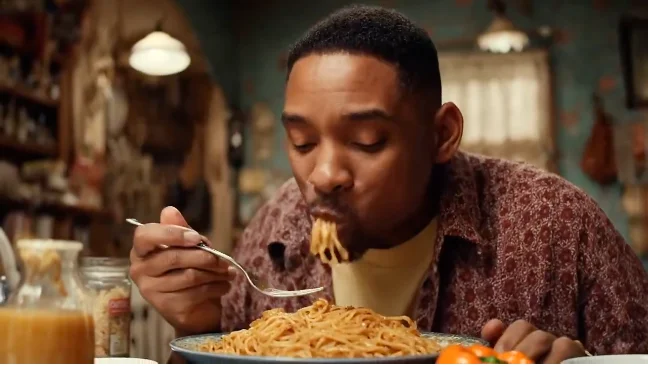
The synthetic Will Smith spaghetti clip became a memorable reference point for AI video. Put the 2023 example beside a 2025 Veo 3 version and the visual difference is striking. But the useful lesson is more specific than “AI can make films now”.
Watch the two examples
Select a load button, then use the player's controls. No clip autoplays. Loading a clip connects your browser to Wikimedia's media host. The source links remain available if playback is unsupported.
2023 · MODELSCOPE EXAMPLE

2025 · VEO 3 EXAMPLE
Watch the action, not just the face
A plausible face in a single frame is one achievement. Keeping it plausible through a mouth movement is another. Pause, resume and watch the transitions: the moment the fork approaches the mouth, the turn of the head, the movement of the food.
| Detail | Question to ask |
|---|---|
| Identity | Does the face remain the same through expressions and movement? |
| Contact | Do hand, fork, food and mouth meet convincingly? |
| Continuity | Do objects keep their shape and position between frames? |
| Motion | Does the action feel purposeful, with believable timing? |
| Sound | Does the audio fit the visible action and material? |
These questions apply to commercial work too. A beautiful product shot can fail when its label shifts during a camera move. A convincing fashion scene can unravel when a sleeve passes behind an arm.
Sound is progress—and another thing to check
Ars Technica's May 2025 reporting identifies Javi Lopez's Veo 3 spaghetti example and notes unusually crunchy eating sounds. It also traces the earlier ModelScope clip and distinguishes it from Will Smith's real-life 2024 parody.
That is a useful reminder: convincing visuals and convincing sound are separate decisions. Listen without watching, then watch without sound. Does each stand up? Putting them together can hide a weakness as easily as it can strengthen a scene.
Why this is not a scientific benchmark
The clips do not share a published, controlled testing protocol. Prompts, output settings, clip length and the number of rejected attempts may differ. The older clip is a memorable early example, not a reliable statement about every tool available in 2023.
Nor should this comparison be read as a test of everything available in 2026. It is a documented pair of historical examples. A model can do well on a familiar short scene and still struggle with a sustained story, precise choreography or continuity across several shots.
Do not mistake a compilation's “2024” segment for AI without checking it: the actor's parody is real footage. A source label matters as much as a model label.
What it means for a creative workflow
Use a short test to discover what a tool can sustain before planning a whole film around it. Start with one action, one subject and one camera idea. Review the complete clip rather than selecting its best frame.
- Keep a record of the model, prompt, references and generation date.
- Check the beginning, middle and end for continuity.
- Allow time for sound, editing, typography and finishing.
- Label synthetic people and obtain appropriate permissions for commercial use of likenesses.
- Do not present a generated scene as documentary evidence.
The spaghetti comparison is useful because it makes change visible. The stronger takeaway is not that judgement is obsolete, but that we now have more material to judge—and more reasons to judge it carefully.
Have a moving-image idea?
Talk to Prompt Punks about a short film or campaign. Start with the story and the intended audience; choose the production method around them.